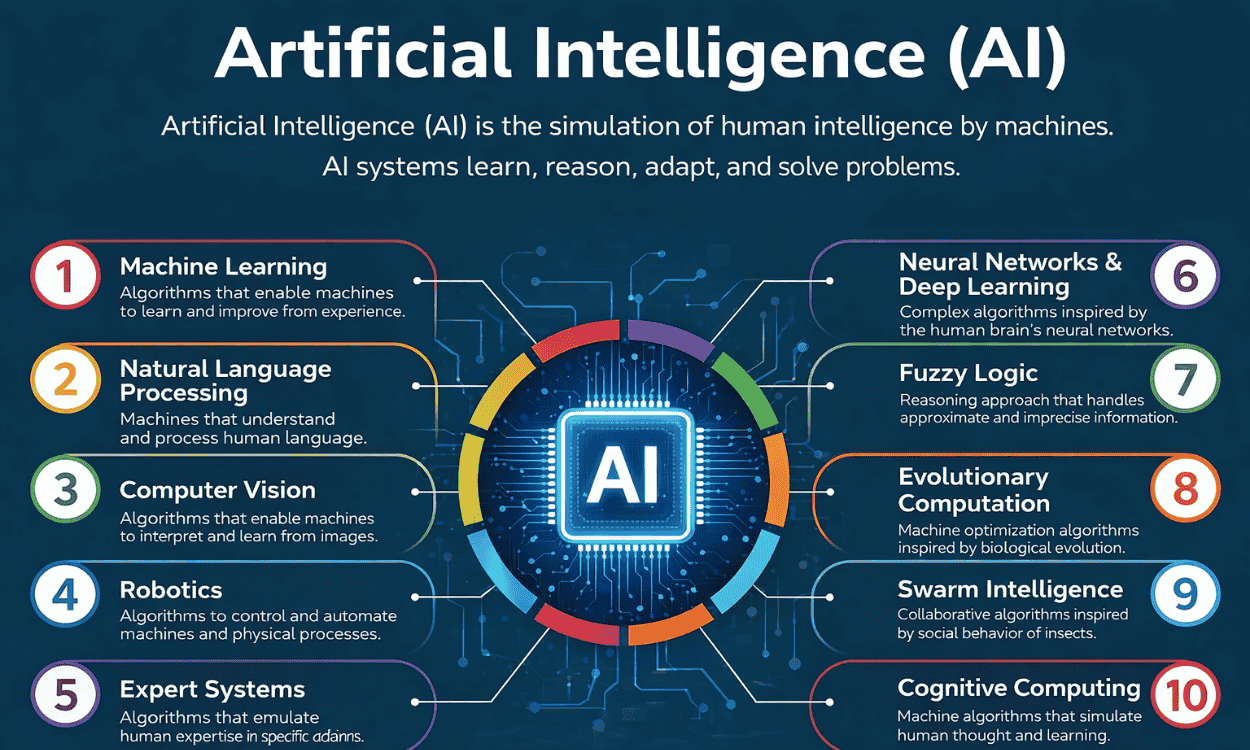
Artificial Intelligence (AI) has rapidly evolved from a specialized research domain into a global force transforming industries workforce models and digital economies. AI fields today span scientific disciplines engineering domains and emerging innovation areas that collectively drive automation predictive intelligence and human machine collaboration.
Understanding how AI works who uses it and where the field is headed has become essential for students professionals and organizations preparing for the future of work.
What Are AI Fields? (Definition Domains & Core Concepts)
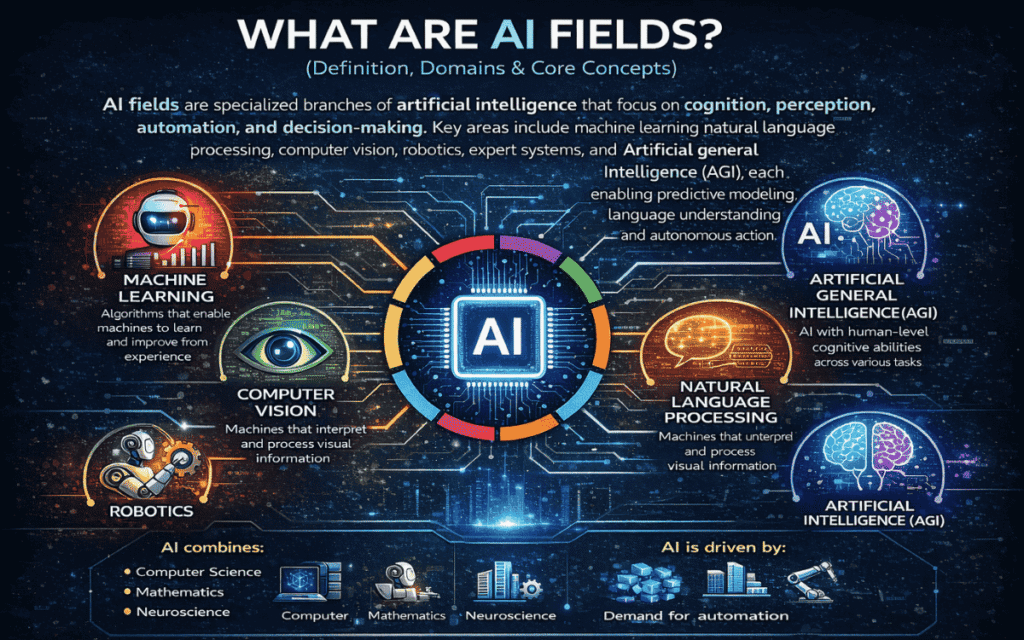
AI fields are specialized branches of artificial intelligence that focus on cognition perception automation and decision making. Key areas include machine learning natural language processing computer vision robotics expert systems and artificial general intelligence (AGI) each enabling predictive modeling language understanding and autonomous action.
AI combines computer science mathematics neuroscience and data engineering improving over time as models process data and learn patterns. Its rapid growth is driven by powerful computing large datasets and the demand for automation and faster decision making. Today AI is used by enterprises startups research labs and governments showing its wide impact across industries and the global economy.
Major AI Fields & Their Real World Use Cases
AI fields have matured into applied domains solving practical problems inside hospitals financial systems vehicles manufacturing lines and digital communication platforms. Real world use cases highlight how AI translates scientific research into measurable outcomes.
Understanding Machine Learning Core AI Field Explained
Machine Learning (ML) is one of the core AI Fields and teaches machines to recognize patterns and make predictions by relying on algorithms that improve with exposure to new data. ML models learn by ingesting large datasets detecting correlations, reducing noise and forming abstractions that generalize to future scenarios.
Through learning paradigms such as supervised unsupervised and reinforcement learning models can categorize data detect anomalies or make reward driven decisions that enhance performance over time.
In finance ML powers fraud detection algorithmic trading and risk modeling while in healthcare it assists in diagnostics and personalized treatment recommendations. Modern SaaS products also leverage ML for recommendation engines marketing automation customer scoring and operational intelligence
What Is NLP? Key AI Field for Human Machine Language Interaction
Natural Language Processing (NLP) is a key field of AI that enables machines to read interpret and generate human language by bridging linguistic structures with computational semantics.
NLP converts raw text into structured meaning through processes such as tokenization language modeling semantic parsing and intent understanding allowing machines to engage in dialogue summarize content answer questions and translate languages.
It plays a foundational role in chatbots AI assistants automated support systems transcription tools sentiment analytics and content generation systems that enhance communication and automate language driven workflows at scale.
Computer Vision (CV)
Computer Vision (CV) is a key AI Field that enables machines to analyze images and video streams to extract meaningful information about the physical world. CV systems leverage convolutional neural networks and multimodal models to detect objects classify patterns segment regions and assess spatial relationships within visual data.
These capabilities drive applications across autonomous driving factory inspection robotic quality control surveillance medical imaging diagnostics and spatial augmented reality experiences making computer vision a cornerstone of modern AI powered systems.
Robotics & Autonomous Systems
Robotics and autonomous systems combine AI with hardware to manipulate environments navigate spaces and perform complex physical tasks. This integration extends automation beyond software into tangible operations supporting smart factories precision agriculture home assistance and autonomous logistics infrastructure as part of Industry 4.0.
Practical applications include robotic surgery for enhanced precision drones for aerial intelligence and autonomous vehicles that leverage multimodal AI to navigate safely through complex conditions making robotics a critical AI Field driving innovation across industries.
Deep Learning & Neural Networks
Deep learning elevates AI by enabling neural networks with multiple processing layers to achieve advanced levels of perception and abstraction. While traditional machine learning struggles with unstructured data deep learning models excel at interpreting language vision audio and multimodal sensory inputs that require hierarchical understanding.
This capability powers major implementations across Big Tech where deep learning drives search engines recommendation systems copilots and creative tools that assist users in work entertainment and research.
The Role of Robotics in AI Automation and Industrial Innovation
Robotics and autonomous systems are a key component of AI Fields automation combining artificial intelligence with hardware to manipulate environments navigate spaces and perform complex physical tasks.
This integration extends AI automation beyond software into tangible operations, enabling smart factories precision agriculture home assistance and autonomous logistics infrastructure as part of Industry 4.0.
Practical applications include robotic surgery for enhanced precision drones for aerial intelligence and autonomous vehicles that leverage multimodal AI to navigate safely through complex conditions making robotics a critical driver of AI automation and innovation across industries.
Careers & Skills in AI Fields (Education, Training & Job Roles)
AI has created strong demand for specialized talent as organizations race to build intelligent products and automate processes. Careers in AI combine theoretical knowledge with practical engineering and research skills.
Who Can Work in AI? (Prerequisites & Technical Background)
Professionals entering AI typically come from backgrounds in computer science mathematics data science software engineering physics or cognitive science. A strong foundation in problem solving and quantitative reasoning is essential.
Essential AI Skills (Math Programming Data Cloud Research)
Core skills include programming with languages such as Python mathematical expertise in linear algebra and calculus statistical modeling familiarity with data pipelines cloud platforms and research methodologies for experimentation.
Top AI Job Roles & Titles (ML Engineer Data Scientist Researcher)
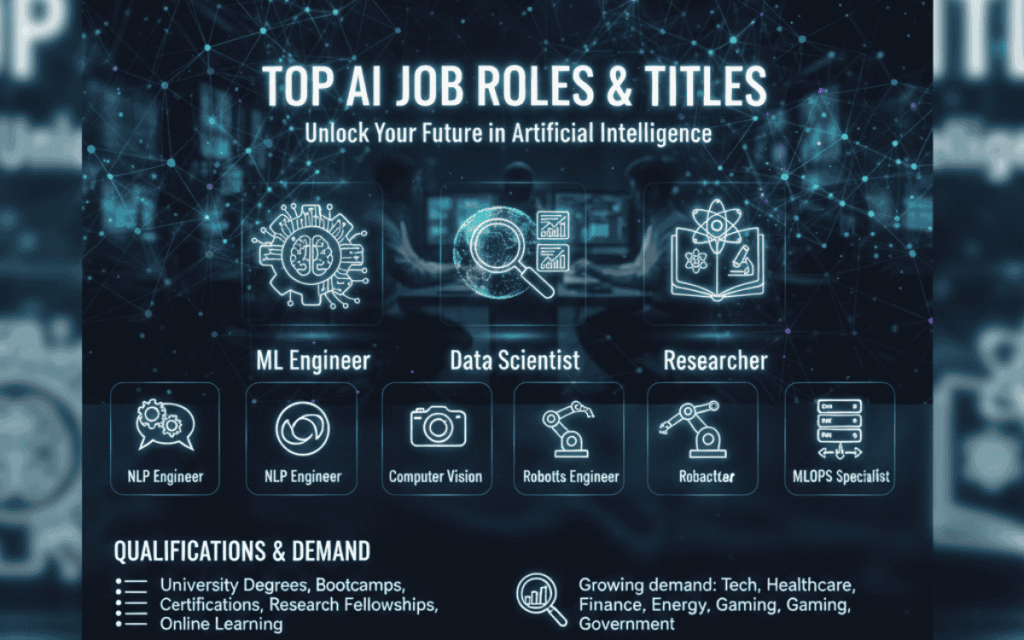
Top AI job roles include machine learning engineers data scientists AI researchers NLP engineers computer vision engineers robotics engineers AI product managers and MLOps specialists who manage deployment pipelines.
Demand for these roles continues to rise across technology healthcare finance energy gaming and government sectors with compensation often exceeding traditional software positions due to limited talent supply and high strategic value.
To qualify for these positions professionals pursue university degrees specialized bootcamps certification programs research fellowships and online learning pathways to stay current with emerging architectures frameworks and applied tools
AI in Industry Adoption ROI & Business Impact
Organizations adopt AI to expand efficiency unlock new business models and enhance customer experiences through intelligent automation.
How Businesses Implement AI for Cost Savings & Automation
AI reduces repetitive workload accelerates analysis and eliminates manual processing through intelligent automation systems integrated into operations workflows and customer facing platforms.
Why Enterprises Invest in AI Competitive & Strategic Benefits
Enterprises invest to gain competitive advantages by improving decision making increasing innovation velocity and enabling data driven business models that outperform traditional processes.
How AI Products Move From Research to Deployment
The AI product lifecycle progresses from research and experimentation to prototyping and scaled deployment requiring ongoing evaluation of data quality performance metrics and operational reliability.
Cloud platforms such as AWS Google Cloud and Azure provide compute resources AI model APIs and containerized orchestration tools that reduce infrastructure overhead and accelerate scaling.
To support production operations MLOps and AIOps frameworks enable training pipelines monitoring A/B experimentation, performance audits and rollbacks ensuring that AI systems remain maintainable reliable and resilient at scale.
Learn AI Fields Online and Boost Your Career
Learning AI Fields provides a structured path to understand the different domains of artificial intelligence including machine learning deep learning natural language processing computer vision robotics and autonomous systems. By exploring these areas individuals can grasp how AI algorithms process data automate tasks and solve real world problems across industries like healthcare finance manufacturing and SaaS.
Platforms like tecrix offer curated courses tutorials and hands on projects that make learning AI Fields more accessible equipping professionals with the skills to design deploy and scale AI powered solutions effectively.
Ethics Risks & Governance in AI Fields
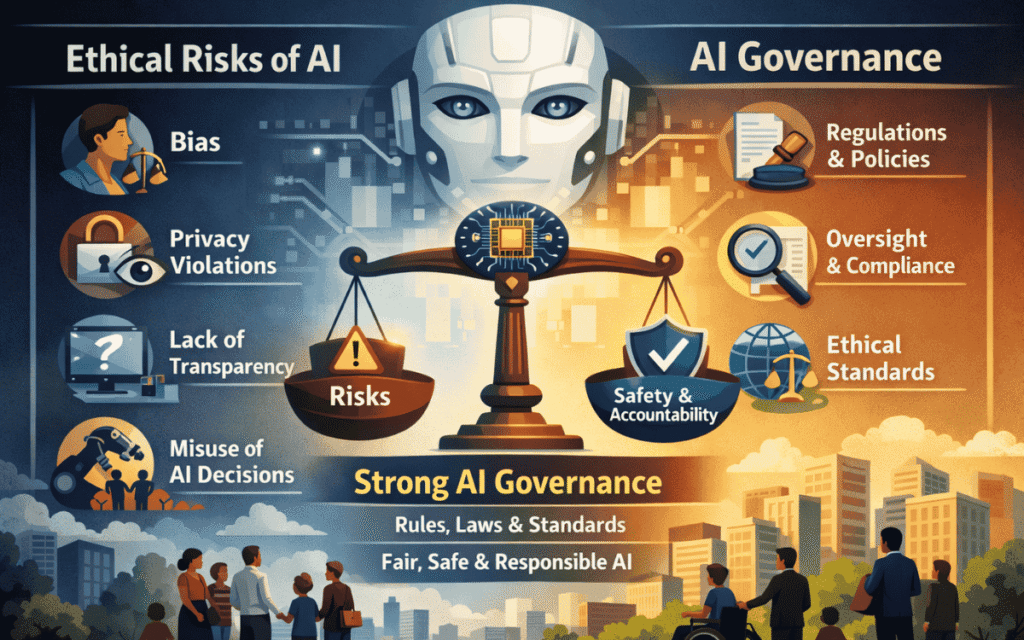
Ethics risks in AI include bias, privacy violations, lack of transparency, and misuse of automated decisions.
Governance in AI means setting rules, laws, and standards to ensure AI is fair, safe, and accountable.
Strong governance helps organizations use AI responsibly while protecting people and society.
As AI capabilities grow so does concern about safety bias transparency and control.
What Ethical Concerns Exist in AI (Bias Safety Accountability)
AI systems can inadvertently produce biased outcomes if training data lacks diversity or proper oversight raising fairness and accountability challenges in sectors such as hiring justice and lending.
Who Regulates AI? (Policies Standards Global Law)
Governments and regulatory bodies are developing AI standards compliance frameworks and safety policies to ensure that AI deployment aligns with societal values and international norms.
How to Ensure Trustworthy Secure & Transparent AI Systems
Ensuring trustworthy AI requires model interpretability data security rigorous validation stakeholder oversight and continuous monitoring to address safety drift and performance degradation.
Conclusion
Artificial intelligence has evolved into a core driver of global innovation with key AI fields such as machine learning NLP robotics computer vision and deep learning transforming industries and digital economies. In the coming decade AI adoption will accelerate through multimodal systems autonomous agents and human AI collaboration enabling higher efficiency and smarter decision making across business science and society.
For students professionals and enterprises understanding AI fields is now essential to staying competitive. Those who invest early in AI skills research and adoption strategies will lead as new career paths business models and innovation opportunities emerge. The future points to a more automated and interconnected world where human and artificial intelligence work together to drive progress.
FAQs
What are AI fields?
AI fields are specialized branches of artificial intelligence such as machine learning, natural language processing, computer vision, robotics, and deep learning that enable machines to learn, reason, and automate tasks.
What are the main applications of AI fields?
AI fields are used in healthcare finance transportation cybersecurity manufacturing retail SaaS products and autonomous systems for automation data analysis prediction and decision making.
Which AI field is growing the fastest?
Generative Ai deep learning and multimodal AI are currently the fastest growing fields due to rapid breakthroughs commercial adoption and integration into consumer and enterprise applications.
What skills are needed to work in AI fields?
AI careers require skills in Python programming mathematics data analysis machine learning neural networks cloud computing and research methods along with continuous learning to stay updated.
Is AI a good career for beginners?
Yes. AI is a strong career option for beginners who build foundational math and programming skills and learn practical machine learning concepts through courses bootcamps and hands on projects.
Can AI replace jobs or create new ones?
AI will automate repetitive tasks but also create new technical research and oversight roles in machine learning data science MLOps AI governance and human AI collaboration fields.
How do companies use AI fields in business?
Companies use AI to reduce operational costs improve decision making enhance customer experience and build data driven products that offer competitive advantage